In Simple Terms
- Why the scale can say you’re fine while you’re quietly losing muscle
- Why ordinary 20s habits (desk job, cardio-only workouts, crash diets) can set this up
- Why most doctors aren’t screening for this in someone your age
- What the evidence actually supports doing about it
On this page
What Sarcopenic Obesity Actually Is
Sarcopenic obesity is a clinical condition defined by the 2022 ESPEN/EASO expert consensus as the co-existence of excess body fat and reduced skeletal muscle mass or muscle function in the same person. It is not simply "being overweight and unfit." It is a specific, measurable combination: a body composition where fat has accumulated while muscle has simultaneously been lost or never adequately built, and the two problems actively reinforce each other.
Excess fat, particularly fat that infiltrates muscle tissue, promotes chronic low-grade inflammation and insulin resistance, both of which accelerate muscle breakdown. Weaker, smaller muscles then burn fewer calories at rest and make physical activity feel harder, which allows fat to accumulate further. This feedback loop is what makes sarcopenic obesity more dangerous than either obesity or low muscle mass on its own, and it is also what makes early intervention so valuable: catching it earlier means shorter exposure to that loop. For the full biological detail behind this cycle, mitochondrial dysfunction, chronic inflammation, and hormonal shifts, see causes and pathophysiology of sarcopenic obesity.
Why Young Adults Are Increasingly Affected
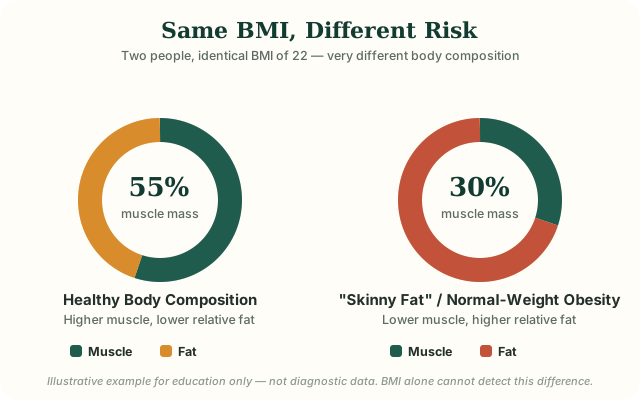
Sarcopenic obesity has historically been described as a disease of aging, where age-related muscle loss (sarcopenia) overlaps with weight gain later in life. That framing is incomplete. The same underlying pattern, excess fat paired with low muscle mass or strength, has been documented in inactive adults in their late teens, twenties, and thirties, well before the age ranges the condition was originally studied in.
A few overlapping factors explain why:
- Normal-weight obesity ("skinny fat"). A young adult can have a completely normal BMI (18.5 to 24.9) while carrying a higher-than-expected body fat percentage, often concentrated around the organs. This pattern is defined by body fat percentage alone, not muscle mass, but it has been linked to roughly four times the cardiometabolic disease risk of a genuinely healthy body composition, and separately, to a substantially higher risk of also having low muscle mass. The two conditions overlap but aren't the same: most people with normal-weight obesity don't meet the full criteria for sarcopenic obesity.
- Sedentary daily patterns. Long hours of sitting, whether for study, screens, or desk work, combined with low daily step counts, has been directly associated with the development of sarcopenic obesity in adults as young as 18. Muscle needs regular mechanical load to maintain itself; without it, strength and mass decline steadily even without any dramatic weight change.
- Low-protein, ultra-processed diets. Diets common among students and early-career adults, heavy in convenience food and light on protein, supply excess energy for fat storage while under-supplying the building blocks muscle needs to repair and grow.
- Cardio-only or crash weight loss. Rapid weight loss through severe calorie restriction or cardio alone, without resistance training, tends to strip muscle along with fat. The scale improves, but body composition can quietly shift toward more fat and less muscle at the same time.
- Hormonal and metabolic conditions. Conditions such as polycystic ovary syndrome (PCOS) and insulin resistance, which frequently emerge in young adulthood, are associated with both fat gain and reduced muscle quality, compounding risk decades earlier than the traditional sarcopenia timeline.
How It's Screened and Diagnosed
Diagnosis under the ESPEN/EASO consensus requires evidence on two fronts: reduced muscle function and excess adiposity, assessed together rather than separately.
Muscle function is typically assessed with simple, low-cost tools, most commonly handgrip strength (measured with a dynamometer) or a five-repetition sit-to-stand test, which times how quickly someone can rise from a chair five times without using their arms. Body composition is assessed through a high percentage of fat mass together with a low amount of appendicular lean mass (muscle in the arms and legs) relative to body weight, typically via bioimpedance analysis or a DEXA scan where available.
Before a full clinical workup, many practitioners use the SARC-F questionnaire, a short, five-item, self-administered screening tool covering strength, walking assistance, rising from a chair, climbing stairs, and falls. It isn't diagnostic on its own, but a high score is a reasonable trigger to pursue a fuller assessment, including in younger patients who wouldn't typically be flagged by age alone.
The practical takeaway for a young adult: BMI and body weight are not diagnostic tools for this condition. If you have risk factors described above, a more useful starting point is asking a healthcare provider about grip strength, waist circumference, or a basic body composition measurement, not another reading of the scale. For a closer look at the full three-step screening, diagnosis, and staging process, see the dedicated page on sarcopenic obesity diagnostic criteria.
Why Most Research Still Focuses on Older Adults
It's worth being direct about a limitation in the evidence base: the large majority of sarcopenic obesity research, including most intervention trials on exercise and nutrition, has been conducted in adults over 60. Population-level prevalence data specific to people in their twenties and thirties remains comparatively sparse, and researchers have explicitly noted this gap when studying protein intake and muscle health in adults aged 20 to 59.
That gap is precisely the motivation behind the research this site accompanies: a project on metabolomic and genetic screening of young Omani adults for sarcopenic obesity and its management through precision nutrition, led by Dr. Zakira Naureen at the University of Nizwa. Closing this evidence gap for younger populations, rather than assuming findings from older adults automatically transfer, is part of why screening and prevention research in this age group matters. For a closer look at what the regional evidence does and doesn't yet show, see sarcopenic obesity in Oman and the Gulf.
What the Evidence Supports for Prevention
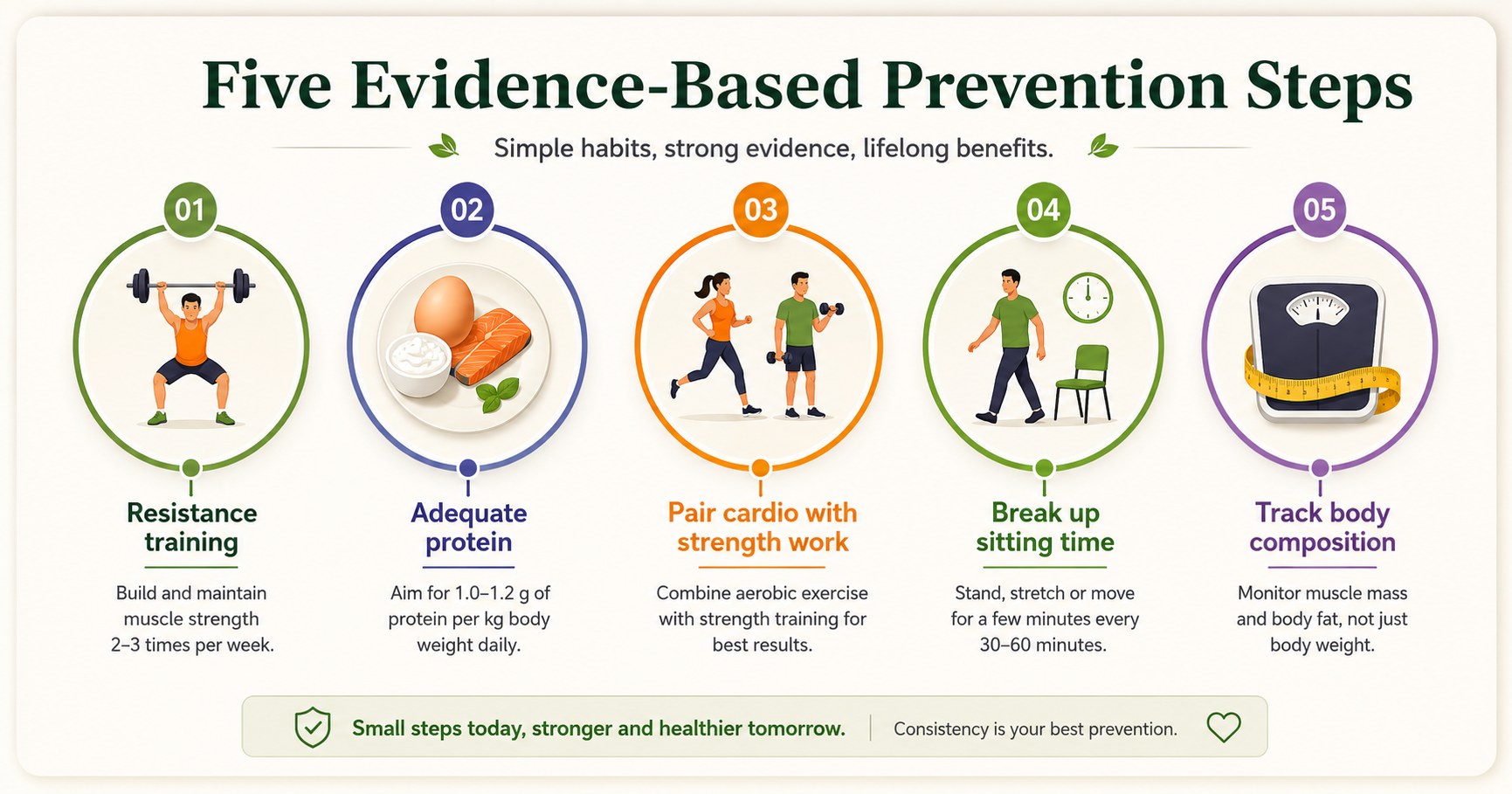
Prioritize resistance training over cardio-only routines
Strength-based exercise two to three times per week is consistently associated with reduced body fat alongside preserved or increased muscle mass, strength, and mobility. Among the interventions studied, this is the single most effective one for directly addressing both sides of the sarcopenic obesity equation at once.
Get adequate protein, spread across the day
Research supports roughly 1.0 to 1.8 grams of protein per kilogram of body weight per day, especially alongside exercise, to protect lean muscle during any period of weight loss. Spreading protein across meals, rather than loading it into one, appears more effective at stimulating muscle protein synthesis than the same total eaten in a single sitting. See sarcopenic obesity and nutrition for the full breakdown, including dietary pattern and supplement evidence.
Avoid pairing calorie deficits with cardio alone
If weight loss is a goal, pairing any calorie deficit with resistance training, rather than relying solely on cardio or severe restriction, helps preserve the muscle that cardio-only or crash approaches tend to sacrifice.
Reduce prolonged sitting, independent of formal workouts
Increasing daily steps and breaking up long sedentary stretches supports both muscle maintenance and metabolic health, even on days without a structured workout.
Track body composition, not just body weight
Waist circumference, grip strength, or a periodic body composition scan give a far more accurate picture of risk than BMI or the scale, at any age, but especially for young adults who are unlikely to be flagged by a routine weight check alone.
Frequently Asked Questions
Can you have sarcopenic obesity at a normal weight?
Yes, sarcopenic obesity can occur at any BMI, including a normal one. This is related to but distinct from normal-weight obesity ("skinny fat"), which is defined by a high body fat percentage at a normal BMI, not by muscle mass. Normal-weight obesity substantially raises the risk of also having low muscle mass, but most people with normal-weight obesity do not meet the full criteria for sarcopenic obesity. BMI and the scale cannot detect either condition; both require a body composition assessment.
At what age can sarcopenic obesity develop?
While it was first described and is most studied in older adults, the underlying pattern has been observed in inactive adults as young as their late teens and twenties, particularly among those with sedentary lifestyles, low-protein diets, or hormonal conditions such as PCOS.
How is sarcopenic obesity diagnosed?
The 2022 ESPEN/EASO consensus recommends assessing muscle function (commonly handgrip strength or a five-repetition sit-to-stand test) alongside body composition (high fat mass together with low appendicular lean mass relative to body weight). Screening tools like SARC-F can flag people who may need a fuller assessment.
Can sarcopenic obesity be reversed?
The body composition changes behind it are generally responsive to intervention, especially early on. Resistance training paired with adequate protein intake is the most consistently supported approach, though outcomes depend on how early the pattern is addressed and any underlying hormonal or metabolic factors.
Is cardio enough to prevent sarcopenic obesity?
Generally not on its own. Weight loss achieved through cardio or calorie restriction without resistance training tends to reduce muscle mass along with fat, which can shift body composition toward the exact pattern that defines sarcopenic obesity, even as total weight goes down.
This guide is for general education and isn't a substitute for personalized medical advice. Speak with a healthcare provider about your individual risk and before starting a new exercise or nutrition program.